The Translation Gap · 2026
The bet was conversational search. I designed a study that could say no. It did.
eduki's Q3 bet was AI-assisted search. Before anything was built, I designed and ran a discovery to find out whether teachers actually want to search in sentences. None of the interview participants did, and the bet didn't go ahead. What they needed was help with the short queries they already type, and that became next-word search suggestions, which shipped.
- Role
- Product Designer: discovery lead, feature design
- Timeframe
- 2026
- Team
- With the search PM. The decision to invest was his.
- Platform
- eduki search, web
- Search
- Discovery
- Research
- Moderated sessions, Greece and Germany
- 7
- Asked for sentence-style search unprompted
- 0 of 7
- Next-word suggestions
- ShippedQualitative signal — not a measured number
The situation
Teachers search eduki the way they'd search a catalogue: a subject and a grade, then done. Something like "brüche klasse 3". The PM's query logs showed most searches are only a few words long.
For Q3, the bet was AI-assisted search: a new search engine, query expansion, "more like this", related searches. The PM's open question was whether teachers actually want a richer, conversational search, or are too pressed for time to use one.
So the question I owned was easy to say and easy to get wrong: are short queries a limitation the search imposes on teachers, or a preference they actually have?
The constraint
A discovery that sits under a roadmap bet can easily end up confirming it. I wanted one that could come back with "no".
- Demand only. No solution design. Relevance and ranking belonged to the search backend, so they were out of scope.
- "No gap" counted as a result. If teachers didn't want sentence search, that was a finding.
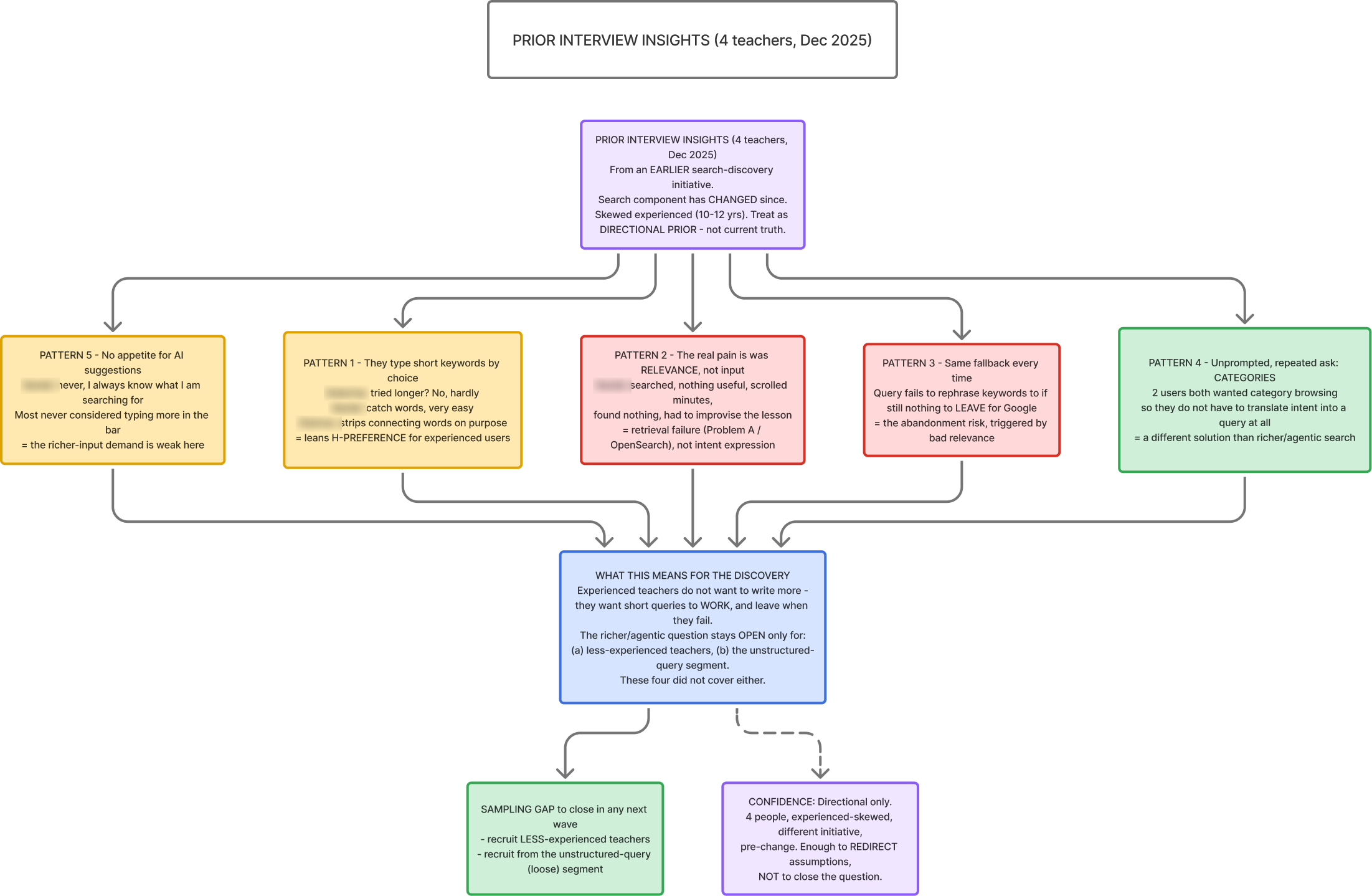
- Priors on the table. Four interviews from an earlier search project leaned towards preference, but only among experienced teachers. That told me who I had to reach.
The decision
I dropped half my own plan. I'd planned moderated sessions plus an unmoderated search task. I cut the unmoderated part. It could only show what teachers type, and with different participants it couldn't even work as a cross-check.
Search first, explain second. I built a moderated "say vs. type" session. Each teacher searched for something real before describing what they needed. If they described it first, they'd naturally type a longer query, and the gap I was measuring would inflate itself. The guide had two branches, gap and no gap, so a session without a gap still produced evidence. And the comparison question never assumed a gap existed.
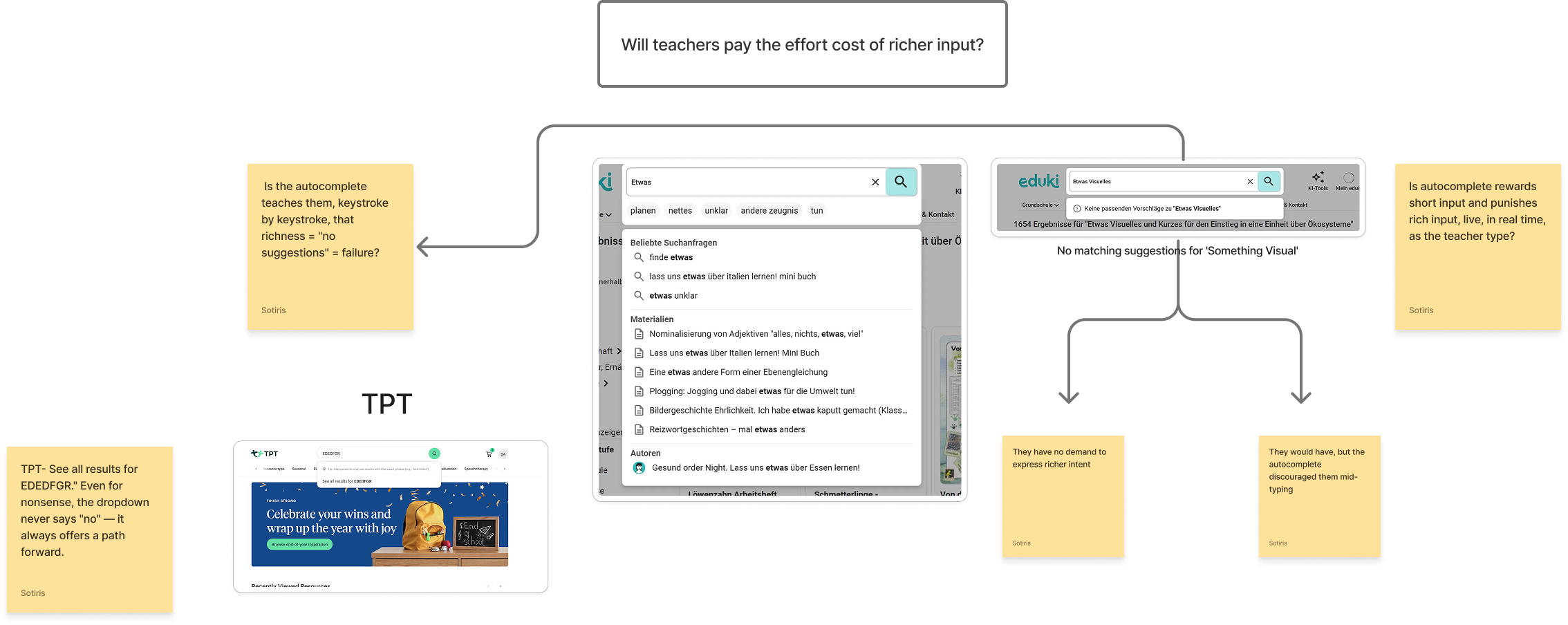
Every failure got a cause. During sessions I tagged each failed search as one of three things: expression (the teacher couldn't put it into words, which was my question), relevance (the results were wrong, which belonged to the backend), or discouragement (the interface pushed back). The clearest case of discouragement: type "something visual" and the suggestions box answers "No matching suggestions".
I stress-tested the guide twice before running it, which caught two flaws that would have sunk it. I wrote the synthesis format against the PM's decision questions, so the readout would answer them directly. And I integrated the PM's own framework, time pressure against how constrained a search is, into the method.
When recruitment stalled, I widened it. I added Greek teachers and tagged every finding by market, so the confound stayed visible. I ran seven moderated sessions in June 2026: five in Greek, which I moderated natively, and two with German teachers, in English.
What seven teachers showed
- Short queries are a strategy, not a limitation. I found five patterns behind them: defensive compression, effort economics, scan-then-narrow, trained narrowing, and exploratory mode.
- 0 of 7 typed or asked for sentence-style search on their own. Willingness only appeared when I raised it, and always with a condition: "if it worked".
- One hint of latent demand. A teacher who writes full sentences to Gemini every day had no idea eduki would accept them.
- The loudest frustration wasn't search. "Can't find it" and "no categories" came from Greek teachers, and traced back to a thinner Greek catalogue and missing category tabs.
- What it pointed to: findability and metadata structure, ahead of natural-language interpretation.
One correction mattered in the synthesis. I used Claude as a synthesis partner, and it had split Greek and German teachers into separate populations. I pushed back: intent doesn't depend on the market, findability does. So intent was pooled across all seven, and only the findability signals the market confounded were set aside. A QA pass caught four overclaims before anything was shared.
The outcome
The study said no, carefully. "No demand appeared" is what seven sessions can support. "No demand exists" would overclaim, and the readout said so. The AI-assisted search bet didn't go ahead.
What teachers did need was help with the short queries they already type, so they can build bigger, more specific ones without writing sentences. That became next-word suggestions: as a teacher types, the search suggests the next term. I designed the feature in Figma and took it through with the developers, who built and shipped it; the suggestions come from the search backend.
The rest of the findings pointed elsewhere. The Greek gaps are a parity problem. And to size the latent demand cheaply, I proposed a painted-door "describe your need" entry point. It was flagged, not prioritised.
Reflection
The most useful thing I built here was a method that could honestly return "no": search-first sessions, a no-gap branch, and a rule that "no gap" counts. A study built to confirm the bet could easily have found demand. This one found that teachers type short on purpose, and that the cheaper win was helping them with the next word.
What I'd do differently: run the German sessions in German. Two sessions in a second language is exactly the kind of friction a study about expression should rule out.
The work